
|
|
Air Carrier Certification | |
 You and the management personnel must be a US citizen.
Your First Decision: You should use a consulting organization such as USAC Aviation.
You will achieve certification better, faster, easier, and cheaper.
You will reduce the processing time from when the FAA begins processing your application.
The quality of your submission will be significantly higher.
The return on investment and time will be significant.
Prerequisites: There are four items required by the FAA:
an aircraft,
qualified flight crew,
commercial aircraft insurance, and
qualified management personnel (ref. CFR 135.119).
Minimum PIC Flight Experience Requirements Part 135.243(b) and (c) require that a PIC who does not hold an ATP certificate and who conducts operations that do not require an ATP certificate must have acquired a minimum number of flight hours before serving as a PIC.
| Pilot | Total |
Cross- Country |
Night
|
VFR PIC
|
500
|
100
|
25*
|
IFR PIC
|
1,200
|
500
|
100
| |
Pre-Application: Your pre-application statement of intent (PASI) is now required to be submitted via the Safety Assurance System:
Exclusive use aircraft.
Director of Operations, Director of Maintenance, and Chief Pilot.
Requested authorizations to be included in the Operations Specifications.
Additional information is included in the data collection tools.
When the FAA is ready to process your application, you will be notified.
The current wait to get started is almost two years.
Next Steps: The next steps are described in the following pages.
Application - Letters, Forms, and Documents
Document Preparation - Manuals and Forms
Aircraft Conformity - Preparation and FAA Inspection
Training - Company Specific Training
Check Ride - FAA Practical Exam as per FAR 135.293-299.
Basic 135 Operator:
Full 135 Operator:
Optional Authorization:
Passenger Seats: The big-ticket items for different size aircraft are:
Same as the Full 135 Operator.
Limit of 5 pilots and 5 aircraft.
Exclusive use of at least one single-engine or multi-engine aircraft.
There are no restrictions on the number or type of aircraft.
There are no restrictions on the number of pilots.
A General Operations Manual and Training Manual are both required.
A qualified Director of Operations and Chief Pilot are required.
A qualified Director of Maintenance is required.
Minimum Equipment List (optional).
Extended over-water operations (optional).
Canadian Foreign Air Carrier Certificate (optional).
Electronic Flight Bag and Electronic Record Keeping (optional).
Areas of operations specified in ops spec B050.
Additional authorizations specified in ops specs.
9 or Less:
General Operations Manual.
10 or More:
Same, plus a General Maintenance Manual
More than 19:
Same as 10 or more plus a Flight Attendant program.
Larger aircraft require additional manuals, which can be labor-intensive.
Agent Data
|
|
(a.k.a. Physical Address) |
Company Data
|
|
Initial Aircraft Data
|
|
|
Additional Aircraft Data
|
|
|
Management Personnel Data (Full 135 Operator)
|
Management People
|
For Each Management Person
|
Flight Standards District Office (FSDO)
|
|
Pre-application Statement of Intent Data
|
|
|
Additional Documentation
|
|
The System Approach for Safety Oversight (SAS) Program Office is responsible for SAS. SAS is not a separate safety standard and does not impose additional requirements on certificate holders. SAS provides aviation safety inspectors with standardized protocols to evaluate certificate holder programs required by regulations to be approved or accepted. It is an automated approach to determine that a certificate holder is able to operate safely under the prescribed regulations and standards.
The configuration of an operator's operating profile is determined by their configuration data (vitals) and desired operations specifications. The SAS process produces a scoped operating profile along with DCT's. The trigger for this process is an initial certificate or a change request for:
|
|
|
The scoped operating profile is used by the Data Collection Tool (DCT) to generate questions whose response determines compliance with the regulations and guidance. Knowledge of this process and policy is fundamental to understanding SAS automation and a successful outcome. SAS, along with the automated analysis within DCT, supports the subsequent approval or acceptance of new or revised manuals; or, the issuance of new or revised operations specifications.
There are five steps in the SAS process:
Operators are mainly involved in Configuration and Data Collection.
Configuration: The Configuration is performed by the FAA principal inspectors with the operator to enter the vitals (operator specific data) the operator's profile.
Data Collection: Data Collection is performed by the operator, much like a compliance statement, to identify compliance and the location in the manual system where the procedures or records are specified. It is an automated process. The data is verified by the FAA principal inspectors. Success results in acceptance, approval, or issuance of the desired item.
Initial Certification: Submit an application package to the certificate-holding district office (CHDO) through the use of the SAS external portal. The applicant will have access to Module 1 for configuration data and to Module 4 for Element Design DCTs (ED DCTs). The CPM will be notified of configuration change requests as they are submitted through the SAS external portal.
FAA-Initiated Change: The FAA may amend OpSpecs or require program revisions when safety in the public interest requires such action. Amendments or revisions can result from significant changes to the certificate holderÂ’s operating environment or safety concerns. If the certificate holder does not use the SAS external portal, the PI must enter the configuration data into the automation with a change request.
Certificate Holder-Initiated Change: The request may be submitted in a letter form or through the use of the SAS external portal. If the external portal is used, the certificate holder will have access to Module 1 for configuration data and to Module 4 for ED DCTs (if required). Regardless of who initiates the change, the certificate holder must submit documentation for the FAA to evaluate the impact of the change.
Although the use of the SAS external portal is not required for existing certificate holders, it is highly recommended. If the certificate holder cannot or does not use the SAS external portal, the PI must enter the configuration data into the automation with a change request.
Revisions may be required to the operator's manual system and the process repeated.
After the principal inspector or certification program manager approves or accepts the change, the operating profile is considered finalized and the vitals are updated. However, if the change affected a change in operations specifications, then the principal inspector or certification project manager will need to update the operations specifications using WebOpss. Once all the changes have been made, the principal inspector or certification project manager should validate the changes in the operating profile and the configuration data.
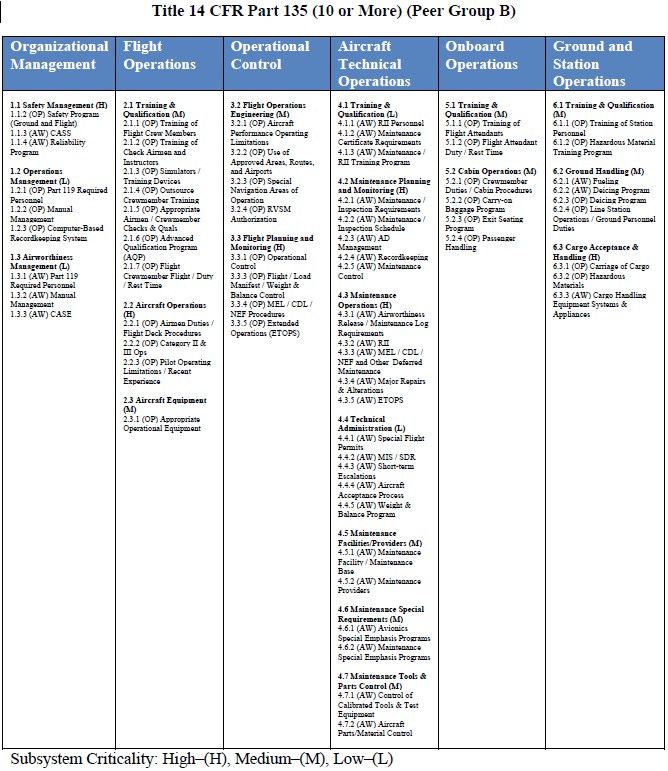
The scope of data that is collected by the Data Collection Tool can be extensive. The data is organized into subsystems (categories) called the Master List of Functions. The DCT generates between 30 and 100 questions per subsystem. An example of the Master List of Functions for a Part 135 10 or more operator is presented below. A full 135 operator with 9 or less passenger seats has many of the same subsystems but fewer questions per subsystem.
An example of an ED DCT set of questions for a small 10 or more operator is presented below. The number of DCT's associated with this operator is 37. Not all the DCT's in the Master List of Functions are applicable because of the small size and scope. The maximum number of questions for a DCT associated with this operator is 138. It is possible to have well over 500 questions for a full 135 10 or more operator.
The operator must answer Yes, No, nor NA in the Answers column. The operator must reference the location in the operator's manual system in the right column. Additional questions may be generated based on an operator's response. Upon successful completion, the FAA POI or CPM will verify the operator's answers. The analysis, assessment, and action is performed by the FAA POI or CPM. A successful outcome results in accepting or approving a manual or issuing operations specifications. The estimated time for an experienced operator to complete the DCT's is about 250 hours (9 or less operators), 500 hours (10 or more), and 1,000 hours (more than 19).
Within ten days of receiving your signed agreement and payment, you will receive access to electronic copies (PDF's) of your manuals for review, including your compliance statement.
Document Compliance: The document compliance phase is designed to assure that your manuals are compliant with the regulations. Your compliance statement must address applicable FAR's, FAA Order 8900.1, and the specific aspects of your proposed operations. We prepare draft documents and you will carefully review the compliance statement and manuals prior to submission. Instructions describe the review process and your responsibilities. When you let us know the FAA is ready to process your application, we will provide documents for you to submit to the FAA.
Note: We prepare compliance statements for FAR Parts 43, 91, 119, and 135. In Part 91 we prepare only those paragraphs that require a record to be maintained or a special procedure. We strongly encourage all Single Pilot operators to use computer based training for general subjects to better be prepared for the oral portion of their check ride.
Aircraft Conformity: Your Director of Maintenance (Full 135 Operator) or maintenance shop will complete an aircraft conformity inspection worksheet. During the aircraft conformity the FAA will examine the details of the following items and verify the accuracy of your conformity inspection worksheet.
|
|
|
Training: All operators will need to complete the following training program. Full 135 Operator must have a General Operations Manual and a Training Manual that defines the details of the procedures and training requirements.
|
|
Checkride: The FAA is going to read everything that you submit.
Oral Exam: The Principal Operations Inspector will administer an oral exam to the Director of Operations, the Chief Pilot, and each Company pilot. The Principal Maintenance Inspector will administer an oral exam to the Director of Maintenance. You need to be intimately familiar with the methods and procedures prescribed in the General Operations Manual and Training Manual. You will also need to know all the appropriate Federal Aviation Regulations pertaining to your operations.
Flight Check: You must complete an FAA flight check ride. You will need to complete a checkride as specified by FAR 135.293 through 135.299. This will consist of an oral exam and a practical flight test. The oral exam will cover the items specified in the Practical Test Standards for Commercial or Airline Transport Pilot certificates along with instrument rating, as appropriate.
Proving Runs: Proving runs are required for turbojet aircraft or aircraft that require two pilots for VFR flight. You will need to plan 25 hours of proving flights with five hours at night. There is usually a reduction though the minimum is 13 hours on initial applicants. We will assist in preparing a proving run flight plan. You will need an FAA approved MEL before the proving runs.
The proving flights are done after all the manuals are approved and the training program completed by all the appropriate personnel. Scheduling these flights should be done as early as possible.