Process   |   6 topics included   |     Chrome 131 or later prints the chapter header and page numbers.

USAC Airways

Process

Contents

  1. Process
  2. Getting Started
  3. Exclusive Use Aircraft
  4. Directors and Chief Pilot
  5. Qualification
  6. Check Ride

Printed November 23, 2026  ·  usac.com/faa2

Description of Certification
Certification → Compliance → Operation

Better, Faster, Easier
— our principles —
Standardization, Automation, and Training

Scope and Experience
Requirements Aircraft Size B050 Experience
    ◉ DO, Chief Pilot, DOM
    ◉ Exclusive Use Aircraft
    ◉ Knowledge and Experience
    ◉ Economic Authority
    ◉ 9 or Less
    ◉ 10 or More
    ◉ More than 19
    ◉ Cert Upgrades
    ◉ US, Canada, Mexico, Caribbean
    ◉ NAT, Pacific Ocean, WATRS, MNPS
    ◉ Africa, Asia, Europe, Indian Ocean
    ◉ Central and South America, Russia

Deliverables
Company Manuals Training Operations Software
    ◉ General Operations Manual
    ◉ General Maintenance Manual
    ◉ Company Training Manual
    ◉ Hazmat Will-Not Carry Manual
    ◉ Minimum Equipment List
    ◉ International Flight Operations
    ◉ Flight Attendant Manual
    ◉ Online Indoc Training
    ◉ General Subjects Training
    ◉ Scenario-Based Oral Prep
    ◉ Advanced Subjects Training
    ◉ Continuing Education Program
    ◉ Scheduling, Dispatching
    ◉ Electronic Record Keeping
    ◉ Electronic Flight Bag
    ◉ Automated Pilot On-Boarding
    ◉ Support for Aircraft Conformity
    ◉ Easy to Use

Home | Getting Started | Selection/Order | Data Entry | Safety Assurance System | Completion | Testimonials

Getting Started

As a US FAA Part 135 or 121 operator:

      You and the management personnel must be a US citizen.

Your First Decision: You should use a consulting organization such as USAC Aviation.

      You will achieve certification better, faster, easier, and cheaper.

      You will reduce the processing time from when the FAA begins processing your application.

      The quality of your submission will be significantly higher.

      The return on investment and time will be significant.

Prerequisites: There are four items required by the FAA:

      an aircraft,

      qualified flight crew,

      commercial aircraft insurance, and

      qualified management personnel (ref. CFR 135.119).

Minimum PIC Flight Experience Requirements Part 135.243(b) and (c) require that a PIC who does not hold an ATP certificate and who conducts operations that do not require an ATP certificate must have acquired a minimum number of flight hours before serving as a PIC.

Pilot Total Cross-
Country
Night
VFR PIC 500 100 25*
IFR PIC 1,200 500 100
*Night cross-country hours.

Pre-Application: Your pre-application statement of intent (PASI) is now required to be submitted via the Safety Assurance System:

      Exclusive use aircraft.

      Director of Operations, Director of Maintenance, and Chief Pilot.

      Requested authorizations to be included in the Operations Specifications.

      Additional information is included in the data collection tools.

      When the FAA is ready to process your application, you will be notified.

      The current wait to get started is almost two years.

Next Steps: The next steps are described in the following pages.

      Application - Letters, Forms, and Documents

      Document Preparation - Manuals and Forms

      Aircraft Conformity - Preparation and FAA Inspection

      Training - Company Specific Training

      Check Ride - FAA Practical Exam as per FAR 135.293-299.

Selection and Order

Basic 135 Operator:

      Same as the Full 135 Operator.

      Limit of 5 pilots and 5 aircraft.

Full 135 Operator:

      Exclusive use of at least one single-engine or multi-engine aircraft.

      There are no restrictions on the number or type of aircraft.

      There are no restrictions on the number of pilots.

      A General Operations Manual and Training Manual are both required.

      A qualified Director of Operations and Chief Pilot are required.

      A qualified Director of Maintenance is required.

Optional Authorization:

      Minimum Equipment List (optional).

      Extended over-water operations (optional).

      Canadian Foreign Air Carrier Certificate (optional).

      Electronic Flight Bag and Electronic Record Keeping (optional).

      Areas of operations specified in ops spec B050.

      Additional authorizations specified in ops specs.

Passenger Seats: The big-ticket items for different size aircraft are:

      9 or Less: General Operations Manual.

      10 or More: Same, plus a General Maintenance Manual

      More than 19: Same as 10 or more plus a Flight Attendant program.

Larger aircraft require additional manuals, which can be labor-intensive.

Data Entry

Data entry takes 30 to 60 minutes. The types of data are listed below.

Agent Data

Name

Phone Number

Email Address (optional)

Your Title

Principal Base of Operations

(a.k.a. Physical Address)

Company Data

Company Name and Address

Doing Business As [Name]

Initial Aircraft Data

Aircraft Registration Number

Aircraft Serial Number

Type of Operation

Passenger Briefing Cards

Make and Model

Aircraft Owner

Type of Aircraft

Geographic Area of Operation

Additional Aircraft Data

Copy of Aircraft Registration

Passenger Briefing Card (copy)

Lease Agreement
(Unless owned by certicate holder.)

Management Personnel Data (Full 135 Operator)

Management People

Director of Operations

Chief Pilot

Director of Maintenance

For Each Management Person

Name and Address

Phone Number

Email Address

Flight Standards District Office (FSDO)

Principal Operations Inspector (POI)

FSDO Address and Phone Number

Pre-application Statement of Intent Data

Proposed Startup Date

Three-Letter Company ID

Additional Documentation

Pilot Resumes and Certificates

Commercial Aircraft Insurance

Drug Abatement Program Information

Safety Assurance System (SAS)

(Order 8900.1 Volume 10. Safety Assurance System Policy and Procedures)

The System Approach for Safety Oversight (SAS) Program Office is responsible for SAS. SAS is not a separate safety standard and does not impose additional requirements on certificate holders. SAS provides aviation safety inspectors with standardized protocols to evaluate certificate holder programs required by regulations to be approved or accepted. It is an automated approach to determine that a certificate holder is able to operate safely under the prescribed regulations and standards.

The configuration of an operator's operating profile is determined by their configuration data (vitals) and desired operations specifications. The SAS process produces a scoped operating profile along with DCT's. The trigger for this process is an initial certificate or a change request for:

Configuration Data

Initial PASI

Scoped ED DCT's

Changes to Scope of Operations

Manuals - Operations, Training, or Maintenance

Minimum Equipment List (Revisions)

The scoped operating profile is used by the Data Collection Tool (DCT) to generate questions whose response determines compliance with the regulations and guidance. Knowledge of this process and policy is fundamental to understanding SAS automation and a successful outcome. SAS, along with the automated analysis within DCT, supports the subsequent approval or acceptance of new or revised manuals; or, the issuance of new or revised operations specifications.

There are five steps in the SAS process:

      1. Configuration
      2. Planning
      3. Resource Management
      4. Data Collection
      5. Analysis Assessment Action

Operators are mainly involved in Configuration and Data Collection.

Configuration: The Configuration is performed by the FAA principal inspectors with the operator to enter the vitals (operator specific data) the operator's profile.

Data Collection: Data Collection is performed by the operator, much like a compliance statement, to identify compliance and the location in the manual system where the procedures or records are specified. It is an automated process. The data is verified by the FAA principal inspectors. Success results in acceptance, approval, or issuance of the desired item.

Procedure for Submitting a Change Request or Application

Initial Certification: Submit an application package to the certificate-holding district office (CHDO) through the use of the SAS external portal. The applicant will have access to Module 1 for configuration data and to Module 4 for Element Design DCTs (ED DCTs). The CPM will be notified of configuration change requests as they are submitted through the SAS external portal.

FAA-Initiated Change: The FAA may amend OpSpecs or require program revisions when safety in the public interest requires such action. Amendments or revisions can result from significant changes to the certificate holder’s operating environment or safety concerns. If the certificate holder does not use the SAS external portal, the PI must enter the configuration data into the automation with a change request.

Certificate Holder-Initiated Change: The request may be submitted in a letter form or through the use of the SAS external portal. If the external portal is used, the certificate holder will have access to Module 1 for configuration data and to Module 4 for ED DCTs (if required). Regardless of who initiates the change, the certificate holder must submit documentation for the FAA to evaluate the impact of the change.

Although the use of the SAS external portal is not required for existing certificate holders, it is highly recommended. If the certificate holder cannot or does not use the SAS external portal, the PI must enter the configuration data into the automation with a change request.

Revisions may be required to the operator's manual system and the process repeated.

After the principal inspector or certification program manager approves or accepts the change, the operating profile is considered finalized and the vitals are updated. However, if the change affected a change in operations specifications, then the principal inspector or certification project manager will need to update the operations specifications using WebOpss. Once all the changes have been made, the principal inspector or certification project manager should validate the changes in the operating profile and the configuration data.

Master List of Functions

The scope of data that is collected by the Data Collection Tool can be extensive. The data is organized into subsystems (categories) called the Master List of Functions. The DCT generates between 30 and 100 questions per subsystem. An example of the Master List of Functions for a Part 135 10 or more operator is presented below. A full 135 operator with 9 or less passenger seats has many of the same subsystems but fewer questions per subsystem.
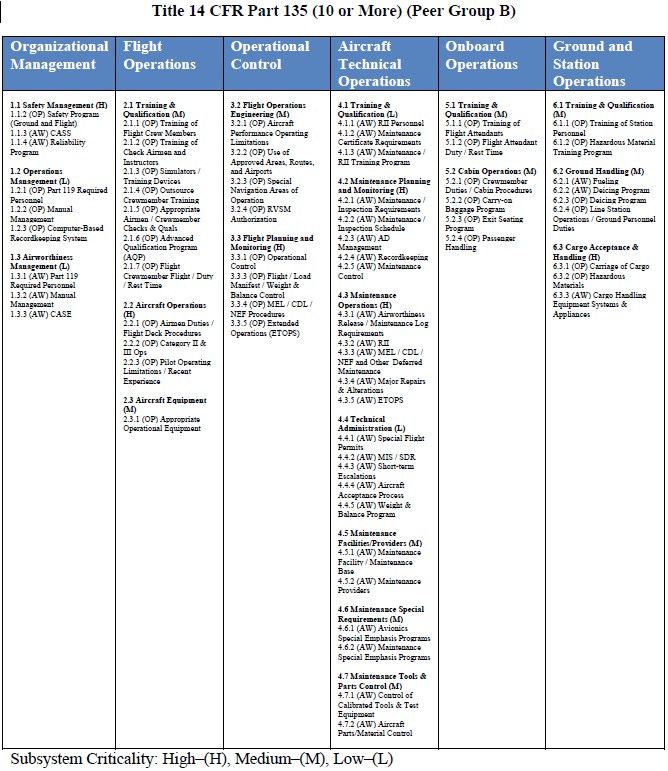

Figure 1. Master List of Functions for Part 135 (10 or More) Operator

Data Collection

An example of an ED DCT set of questions for a small 10 or more operator is presented below. The number of DCT's associated with this operator is 37. Not all the DCT's in the Master List of Functions are applicable because of the small size and scope. The maximum number of questions for a DCT associated with this operator is 138. It is possible to have well over 500 questions for a full 135 10 or more operator.

ED DCT for Flight Crew Training
(Scroll to View)
--- END ---

The operator must answer Yes, No, nor NA in the Answers column. The operator must reference the location in the operator's manual system in the right column. Additional questions may be generated based on an operator's response. Upon successful completion, the FAA POI or CPM will verify the operator's answers. The analysis, assessment, and action is performed by the FAA POI or CPM. A successful outcome results in accepting or approving a manual or issuing operations specifications. The estimated time for an experienced operator to complete the DCT's is about 250 hours (9 or less operators), 500 hours (10 or more), and 1,000 hours (more than 19).

Completion

Within ten days of receiving your signed agreement and payment, you will receive access to electronic copies (PDF's) of your manuals for review, including your compliance statement.

Document Compliance: The document compliance phase is designed to assure that your manuals are compliant with the regulations. Your compliance statement must address applicable FAR's, FAA Order 8900.1, and the specific aspects of your proposed operations. We prepare draft documents and you will carefully review the compliance statement and manuals prior to submission. Instructions describe the review process and your responsibilities. When you let us know the FAA is ready to process your application, we will provide documents for you to submit to the FAA.

Note: We prepare compliance statements for FAR Parts 43, 91, 119, and 135. In Part 91 we prepare only those paragraphs that require a record to be maintained or a special procedure. We strongly encourage all Single Pilot operators to use computer based training for general subjects to better be prepared for the oral portion of their check ride.

Aircraft Conformity: Your Director of Maintenance (Full 135 Operator) or maintenance shop will complete an aircraft conformity inspection worksheet. During the aircraft conformity the FAA will examine the details of the following items and verify the accuracy of your conformity inspection worksheet.

Time Critical Components

Airworthiness Directives

Aircraft Inspections

Supplemental Type Certificates

Yellow Tags or Form 8410

Physical Inspection

Lease Agreement

Training: All operators will need to complete the following training program. Full 135 Operator must have a General Operations Manual and a Training Manual that defines the details of the procedures and training requirements.

Indoc Training (Company Specific)

General Subjects Training

Flight Training

Checkride: The FAA is going to read everything that you submit.

Oral Exam: The Principal Operations Inspector will administer an oral exam to the Director of Operations, the Chief Pilot, and each Company pilot. The Principal Maintenance Inspector will administer an oral exam to the Director of Maintenance. You need to be intimately familiar with the methods and procedures prescribed in the General Operations Manual and Training Manual. You will also need to know all the appropriate Federal Aviation Regulations pertaining to your operations.

Flight Check: You must complete an FAA flight check ride. You will need to complete a checkride as specified by FAR 135.293 through 135.299. This will consist of an oral exam and a practical flight test. The oral exam will cover the items specified in the Practical Test Standards for Commercial or Airline Transport Pilot certificates along with instrument rating, as appropriate.

Proving Runs: Proving runs are required for turbojet aircraft or aircraft that require two pilots for VFR flight. You will need to plan 25 hours of proving flights with five hours at night. There is usually a reduction though the minimum is 13 hours on initial applicants. We will assist in preparing a proving run flight plan. You will need an FAA approved MEL before the proving runs.

The proving flights are done after all the manuals are approved and the training program completed by all the appropriate personnel. Scheduling these flights should be done as early as possible.
Exclusive Use Aircraft

You must have one of the following:
        ◉ Aircraft registration showing the Operator owns the aircraft.
        ◉ An exclusive use dry lease agreement that -
              ❍ Must be between registered owner and Operator.
The Exclusive Use Dry Lease Agreement must address:
        ◉ Aircraft make and model, serial number, and FAA registration number.
        ◉ Term must be 6 months or greater.
        ◉ Rent or amount to be paid on an hourly basis, or equivalent.
        ◉ Maintenance responsible party and details.
        ◉ Possession, Command and Operational Control details.
        ◉ Payment of taxes.
        ◉ Restriction on liens.
        ◉ Payment and details of insurance.
        ◉ Consequences of default.
        ◉ Additional contractual details.
        ◉ Signatures.
Examples can be found at Onecle.
USAC can tailor an exclusive use dry lease agreement during certification.
Compliance with Truth-In-Leasing requirements:
        ◉ Applies to aircraft over 12,500 pounds.
        ◉ Assure lease complies with CFR 91.23.
        ◉ Mail or deliver a copy of the agreement within 24 hours of signing to
              ❍ FAA Aircraft Registration Branch (AFS-750)
                  Attn: Technical Section
                  PO Box 25724
                  Oklahoma City, OK 73125
        ◉ Notify POI at least 48 hours prior to first flight under the agreement.
        ◉ Carry a copy of the agreement in the EFB.

President and Managers

President

Must Exercise Operational Control
--- and ---


Provide guidance to all personnel.
Make final decisions on hiring and firing of all personnel.
Know the company�s manuals
Know applicable regulations and laws.
Assure all flights are regulatory compliant.
Provide adequate personnel and resources.
Assure compliance with duty time and rest requirements.
Obtain necessary international clearances, as applicable.
Manage the Drug and Alcohol program as required by the FAA.

Director of Operations
Must Have Knowledge and Experience
--- to ---

Act on behalf of the President in his absence.
Assume the duties of the Chief Pilot in his absence.
Assure training programs are are compliant and implemented.
Assure that flight crews are properly trained and equipped.
Assist Chief Pilot as necessary in crew training.
Responsible for the entire scope of the flight department.
    ◉ Manage operations, maintenance, sales, and customer service.
    ◉ Coordinate the flight department�s activities with customers.
Implement and exercise operational control:
    ◉ Assure Company aircraft operated safely and are regulatory compliant.
    ◉ Assure all personnel have access to appropriate manuals.
    ◉ Manage the MEL (Minimum Equipment List) Program.
    ◉ Supervise the Chief Pilot and other employees.
    ◉ Schedule aircraft flights and assure compliance with inspections.
Exercise authority to act for the Certificate holder:
    ◉ Revise and submit to the FAA all manuals and manual revisions.
    ◉ Communicate with the DOT and NTSB.
    ◉ Sign FAA correspondence and Operations Specifications.
    ◉ Report accidents and incidents per Company procedures.
Involvement with employment:
    ◉ Hire and fire personnel.
    ◉ Participate in merit review and compensation of employees.
    ◉ Manage key personnel related to flight operations.
Implementation the FAA approved anti-drug and alcohol program.
Coordinate with the Director of Maintenance on:
    ◉ Policies regarding Company aircraft maintenance standards and procedures.
    ◉ The timely correction of mechanical irregularities and discrepancies.
Conduct Company ground and emergency training in accordance.
Establishe, monitor, and maintain Company files and pilot records.
Implement corporate policies and directives.

Chief Pilot
Must Have Knowledge and Experience
--- to ---

Schedule appropriate training.
Assure all training is completed and recorded.
Maintain a status of all crew members to include:
    ◉ Recurrent check rides, ground school and medical status.
Schedule crews for all flights insuring the crews are current and qualified.
Assure duty day, flight time and rest periods are regulatory compliant.
Act on behalf of the Director of Operations in his absence.
Keep crew member records member to include training, currency, and medicals.
Assure trip report books are complete and ready for crew at departure.
Coordinate with the DOM to ensure all current forms are aboard the aircraft.
Assure the proper and adequate information is made available to each crew member.
Exercise operational control in concert with the Director of Operations:
    ◉ Schedule, assign, and dispatche Company aircraft and crewmembers.
    ◉ Assign Captain duties.
    ◉ Supervise flight crew personnel.
    ◉ Conduct or supervise all training activities of flight crew personnel.
    ◉ All flight duty assignments are in accordance with FAR 135.95.
Involvement with employment:
    ◉ Assess pilot qualifications and assists in hiring and firing.
    ◉ Participate in merit review and compensation of employees.
    ◉ Direct key personnel related to flight operations.
Coordinate international procedures, permits, licenses and flights are regulatory compliant.
Maintain current operational flight data:
    ◉ Disseminate charts, manuals, NOTAMS, and other information to crewmembers.
    ◉ Disseminate Company policies and regulations to crewmembers.
    ◉ Keep the aircraft copies of this GOM and other required documents current.
    ◉ Assure the current weight and balance data is aboard.
Maintain required crewmember files and records.
    ◉ Assure that all crewmembers are certified and supervised according to the FAR�s.
    ◉ Maintain proficiency records, pilot files, flight schedules, and duty time records.
    ◉ Prepare reports and correspondence pertaining to flight operations activities.
    ◉ Submit all reports regarding flight personnel to the Director of Operations.
    ◉ Maintain training records.
Assist the Director of Operations:
    ◉ Formulate operations policies.
    ◉ Prepare and manage revisions of the GOM, Ops Specs, and Training Manuals.
    ◉ Accident and incident reporting.
Conduct Company flight, ground, and emergency training and testing.
Maintain proficiency as Pilot-in-Command.

Director of Maintenance
Must Have Knowledge and Experience
--- to ---

Responsible for the airworthiness of all Company aircraft.
Assist, supervise, train and direct all personnel assigned to the maintenance department.
    ◉ Provide initial and recurrent training to maintenance personnel.
    ◉ Maintain maintenance training records.
    ◉ Assure all maintenance personnel have completed drug and alcohol training.
    ◉ Assure that maintenance personnel have the appropriate training, certificates, tools, and facilities.
    ◉ Assure compliance with Company procedures and FAA regulations.
    ◉ Hire and terminate maintenance personnel.
Exercise Operational Control
    ◉ Suspend operation of the aircraft in concert with crewmembers and management personnel
    ◉ Return an aircraft to service.
    ◉ Aircraft operations shall be suspended when aircraft airworthiness is in doubt.
    ◉ Maintain appropriate maintenance records.
Drug and Alcohol Misuse Program: Assure compliance with FAA and DOT requirements.
    ◉ Assure compliance with the drug and alcohol program.
    ◉ Complete the Company�s approved drug and alcohol training for supervisors.
    ◉ Adhere to the Company�s FAA approved drug and alcohol program.
Assure Aircraft Airworthiness
    ◉ Assure maintenance conforms to CFR 135 at all times.
    ◉ Have defects repaired as per CFR part 43.
    ◉ Maintain the Aircraft Inspection Status sheet aboard the aircraft.
    ◉ Keep Maintenance Tracking Software current and accurate.
    ◉ Assure that no time limits are exceeded.
Aircraft Maintenance:
    ◉ Assure compliance with applicable CFR�s, AD's, ops specs.
    ◉ Shall all aircraft are reweighed as directed by CFR 135.185.
    ◉ Coordinate maintenance scheduling with the Director of Operations.
    ◉ Assure that no time limit is exceed and required maintenance is performed.
    ◉ Shall maintenance is performed by certified and qualified personnel.
    ◉ Schedule and track routine maintenance
    ◉ Schedule and track time limited component changes and unscheduled maintenance.
    ◉ Assure maintenance records are completed prior to due dates.
    ◉ Assure parts and or components are ordered and received on time.
    ◉ Initiate requisitions for stock and material required.
    ◉ Manage the Continuing Analysis and Surveillance System.
    ◉ Assure all equipment and tools are in serviceable condition.
    ◉ Review service bulletins, service letters, AD�s for applicability.
    ◉ Make overhaul manuals, service bulletins, airworthiness directives available.
    ◉ Revise and distribute Time Limits data, as appropriate.
    ◉ Schedule a flight check as required.
    ◉ Maintain calibration records for precision tools and test equipment.
    ◉ Assure tools and equipment are calibrated within the calibration interval.
Mechanical Irregularities (reported by the flight crew):
    ◉ Review the flight records to ensure all discrepancies are properly addressed.
    ◉ Assure the maintenance write-ups are properly completed and addressed.
    ◉ Adhere to the above aircraft maintenance procedures.
Responsible for conducting all conformity inspections of aircraft.
Assure contract maintenance is compliant with the GMM procedures.
    ◉ Ensure the contracting agent has the capability of performing the maintenance.
        ❍ Certified repair station with an air agency certificate and ops specs; or,
        ❍ An individual with appropriate certificates, ratings, training, and drug program.
    ◉ Provide aircraft maintenance manuals and Company procedures.
    ◉ Ensure compliance with Company maintenance procedures.
    ◉ Ensure that the contracting agent has the appropriate tools and facilities.
    ◉ Ensure that FAA approved parts are used.
    ◉ Assure that required FAA approved technical data is available.
    ◉ Ensure the aircraft was properly returned to service.
Minimum Equipment List: Prepare and maintain the following manuals and records:
    ◉ Create and revise, as needed, the MEL.
    ◉ Create and revise, as needed, the NEF.
    ◉ Prepare and maintain the MEL Extension Form. Form)
    ◉ Collaborate with the flight crew to assure that inoperative items are properly addressed.
Maintain maintenance procedures and Ops Specs and any manual revisions.
    ◉ General Maintenance Manual.
    ◉ Operations Specifications section D and E (authorized to sign these ops specs).
    ◉ General Operations Manual (maintenance sections).
Weight and Balance: Manage the weight and balance program for each aircraft.
    ◉ Weight the aircraft every three years according to approved procedures.
    ◉ Assure the weight and balance is properly documented and recorded.
    ◉ Assure weight and balance documentation is aboard each aircraft.
    ◉ Assure weight and balance data has been distributed to flight operations.
Liaison:
    ◉ FAA � Communicate with CHDO PMI.
    ◉ Flight Operations � Maintains a working relationship with flight operations personnel.
Special Reports: When required, prepare the following:
    ◉ Service Difficulty Reports [CFR 135.415]
    ◉ Mechanical Interruption Summary Reports [CFR 135.417]
    ◉ Additional Maintenance Requirements [CFR 135.421]
    ◉ As appropriate, maintain the following:
        ❍ Any required or desired audits of maintenance facilities.
        ❍ Any required or desired self-audits.
        ❍ Initiate and manage Short Term Escalations.
        ❍ Surveillance and/or improvement programs.

Qualification

Chief Pilot

ATP or Commercial Pilot Certificate.
Appropriate aircraft ratings and endorsements.
Current FAA First or Second Class Medical certificate, as per AFM.
Minimum of 3 years as Captain under Part 121, 125, or 135; or,
Previously been assigned as Chief Pilot under Part 121, 125, or 135.
Minimum of 1200 total flight time, 500 cross-country, and 100 night flight time.
Must maintain currency as Captain in at least one aircraft used on the certificate.

Director of Maintenance

Posses a valid Airframe and Power Plant license.
Must have:

  1. Three years of experience within the past 6 years maintaining aircraft as a certificated Maintenance Technician, including, at the time of appointment as Director of Maintenance, experience in maintaining the same category and class of aircraft as the certificate holder uses; or
  2. Three years of experience within the past 6 years repairing aircraft in a certificated airframe repair station, including 1 year in the capacity of approving aircraft for return to service.

Chief Inspector

Must possess a valid Airframe and Power Plant license.
Must be compliant with:

  1. Hold a Maintenance Technician certificate with both airframe and powerplant ratings, and have held these ratings for at least 3 years;
  2. If applicable, have at least 3 years of maintenance experience on different types of large airplanes with 10 or more passenger seats with an air carrier or certificated repair station, 1 year of which must have been as maintenance inspector; and
  3. Have at least 1 year of experience in a supervisory capacity maintaining the same category and class of aircraft as the Company uses.

Required Item Inspector
  1. Qualification: On the job training maybe substituted in place of a formal training on a case by case basis and only by the Director of Maintenance. Procedures for qualifying an RII Inspector are:
    1. Inspectors shall be appropriately certificated, trained, qualified, and authorized in accordance with the Company General Maintenance Manual. Inspectors shall have an FAA Inspection Authorization (IA) and training from the manufacturer; or, training based on aircraft type, complexity, and the nature of the inspections to be performed.
    2. Formal Training and On-the-Job Training shall include an oral or written test to assure the RII Inspector possesses the requisite knowledge and skills to perform the required inspections.
  2. Training: Training shall consist of familiarization with Company maintenance manual system and the applicable portions of it, in accordance with the nature of the item being inspected.
  3. Authorization: Authorization shall be issued to those personnel meeting these prerequisites as specified above by letter from the Director of Maintenance of the Company. This authorization shall be included in the RII Inspector Letter of Authorization, and shall state the scope and limits of the inspector's authority.

Captain

ATP or Commercial Pilot Certificate.
Appropriate aircraft ratings and endorsements.
Current FAA First or Second Class Medical certificate, as per AFM.
Minimum of 3 years as Captain under Part 121, 125, or 135; or,
Previously been assigned as Chief Pilot under Part 121, 125, or 135.
Minimum of 1200 total flight time, 500 cross-country, and 100 night flight time.
At lease 75 hours under actual or simulated instrument conditions.
And 50 hours must be in actual flight.
Must meet recent instrument experience as per CFR 61, as required.

First Officer

ATP or Commercial Pilot Certificate.
Appropriate aircraft ratings and endorsements.
Current FAA First or Second Class Medical certificate, as per AFM.
Minimum experience as per CFR 135.245.

Additional requirements apply.

Check Ride

All flight crew members shall satisfactorily complete the appropriate check rides prescribed by CFR Part 135 as follows:
  1. Line Check [CFR 135.299] � Captain only.
    1. Within the preceding 12 calendar months, the Captain must have satisfactorily completed a line check conducted by an approved Company check pilot or an FAA Safety Inspector in operations under CFR Part 135 in one of the types of aircraft listed in the operations specifications, paragraph D-085.
    2. The Line Check shall be recorded using the Airman Competency Proficiency Check, FAA Form 8410-3.
    3. The original will be placed in the pilot�s permanent records or a scanned copy stored in the pilots electronic record, when electronic recordkeeping is approved.
  2. Proficiency/Competency Check [CFR 135.293, CFR 135.297]
    1. Within the preceding 12 calendar months, each pilot shall have passed a written or oral test given by the Administrator or an authorized check airman as prescribed in CFR 135.293(a). In addition, the pilot shall have completed a Proficiency / Competency Check in the category, class and type (if a type rating is required) to which that pilot is assigned as follows:
      1. Captain [CFR 135.293(b), 135.297]
        1. A Proficiency Check conducted either by the Administrator or an approved Check Pilot within the preceding 12 calendar months and, in addition,
        2. An Instrument Proficiency Check (simulator or aircraft) within the preceding 6 calendar months, when the pilot is to be assigned any flight under Instrument Flight Rules.
      2. First Officer [CFR 135.293(b), CFR 135.245, 61.57]
        1. A Competency Check [CFR 135.293(b)/CFR 135.245] conducted either by the Administrator or an approved Check Pilot within the preceding 12 calendar months, AND, for flight under IFR,
        2. An Instrument Proficiency Check [CFR 61.57(d)(1)] conducted either by the Administrator, an approved Check Pilot, or a certified instrument flight instructor within the preceding six calendar months or performed and logged under actual or simulated instrument conditions: (1) six instrument approaches, (2) holding procedures, and (3) intercepting and tracking courses through the use of navigation systems within the preceding six calendar months.
        3. The Airman Competency/Proficiency Check, FAA Form 8410-3, will be used to record the First Officer Proficiency/Competency Check. (�First Officer Instrument Competency Check� will be indicated under Remarks and will not be recorded as a 135.297 check.)
  3. Route Certification and Airport Qualification [CFR 135.299(c)]
    Any Captain, who has not flown over a route and into an airport within the preceding 90 days, shall meet the requirements specified in Section 4.11.1.